

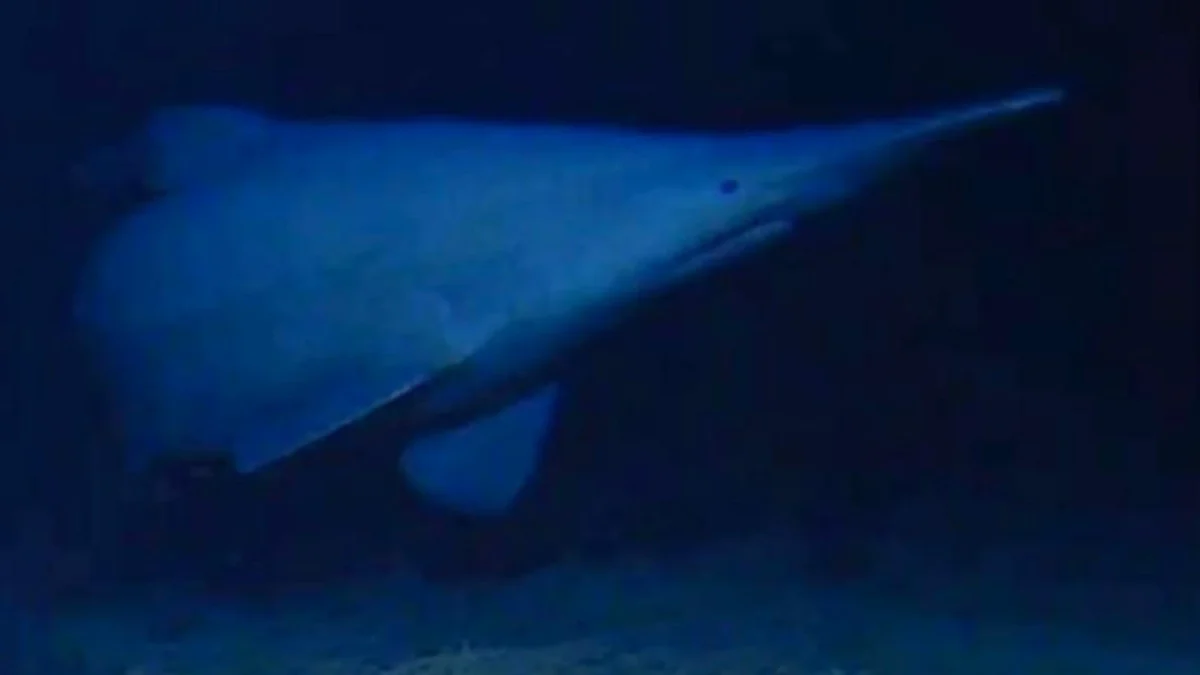
Rare Goblin Shark Filmed in the Wild for the First Time, Study Says
Rare goblin shark filmed in the wild – For the first time in scientific history, researchers have successfully documented and verified footage of the goblin shark, a seldom-seen deep-sea species, in its natural habitat, according to a recent study. This breakthrough was made possible through advanced underwater technology, marking a significant milestone in marine biology. The goblin shark, scientifically known as Mitsukurina owstoni, belongs to the ancient Mitsukurinidae family, which has existed for approximately 125 million years. As a living fossil, its discovery in the wild has reignited interest in the evolutionary history of deep-sea predators.
A Unique Deep-Sea Predator
The goblin shark’s most distinctive features include its elongated, horn-like rostrum and its ability to rapidly extend its jaws to capture prey. These traits, which have remained largely unchanged over millions of years, make it a fascinating subject for study. According to Aaron Judah, a PhD candidate at the University of Hawaii at Manoa, the species is particularly notable for its “enormous rostrum,” which functions as a sensory tool. This structure is lined with Ampullae of Lorenzini, specialized electric receptors that help the shark detect prey in the darkest depths of the ocean.
“The rostrum is covered in Ampullae of Lorenzini, which are electroreceptors filled with gel-like material. These allow the goblin shark to sense the faint electrical signals emitted by squid, fish, and crustaceans, even in complete darkness,” Judah explained to ABC News.
Despite their historical presence in the fossil record, live sightings of goblin sharks have been rare. Most encounters occur in fisheries, where the species is occasionally caught, but rarely observed in detail. This scarcity has made the recent findings all the more impactful, as they provide concrete evidence of the shark’s distribution and behavior in the wild.
First Confirmation in 2019
The first confirmed footage of the goblin shark in its natural environment came in 2019 during an expedition led by the Ocean Exploration Trust’s EV Nautilus. The remotely operated vehicle (ROV) captured the species near Jarvis Island, an uninhabited coral atoll in the Pacific Remote Islands Marine National Monument. At that time, the team was unaware of the significance of their discovery, as Steve Auscavitch, a PhD scientist at the Smithsonian Institution’s National Museum of Natural History, recounted.
“When we first saw the shark, three-quarters of a mile beneath the surface, we didn’t immediately recognize it. No one on board had prior knowledge of its presence in that region,” Auscavitch told ABC News.
The footage provided a brief glimpse of the creature, but the excitement grew when Judah later learned of additional unreviewed recordings stored in a database managed by his lab. These materials, he noted, confirmed the presence of goblin sharks in a new geographic area, offering crucial data for conservation efforts.
2024 Discovery in the Tonga Trench
In a separate event, scientists captured baited camera footage of the goblin shark in 2024 near the Tonga Trench. This location, approximately 1,250 miles southwest of Jarvis Island, is part of a vast, unexplored region of the Pacific. The collaboration with the University of Western Australia’s Deep-Sea Research Center led to the first documented sighting of the species in trench slopes, a development that expands its known habitat range.
“This is the first time we’ve seen the goblin shark inhabiting trench slopes, which are critical ecosystems for deep-sea life,” Judah said, emphasizing the importance of these discoveries.
The study, published in the Journal of Fish Biology, highlights how goblin sharks have now been recorded in three major ocean basins: the Pacific, Atlantic, and Indian Oceans. This widespread distribution underscores the need for further research into their ecological roles and survival strategies.
Significance of Seamounts
Seamounts—underwater mountains that rise from the ocean floor—have long been recognized as vital habitats for marine biodiversity. The recent sightings of goblin sharks near these structures provide new insights into their behavior and adaptability. Judah explained that these habitats offer unique ecological niches, often teeming with life that thrives in the cold, nutrient-rich waters surrounding them.
The goblin shark’s presence in seamounts and trenches suggests it may have evolved specialized traits to survive in these extreme environments. Its ability to detect prey using electroreception and its ghostly, pinkish or pale white coloration further distinguish it from other shark species. These characteristics, combined with its ancient lineage, make it a key indicator of deep-sea ecosystems’ health.
Conservation and Future Implications
As fisheries increasingly target deeper waters, the goblin shark’s survival faces growing challenges. The recent footage not only confirms its existence in new regions but also supports the need for targeted conservation measures. “Every new discovery helps us refine our understanding of rare species and develop more effective strategies to protect ocean biodiversity,” Judah added.
James Lea, CEO of the Save Our Seas Foundation, echoed this sentiment, noting that the goblin shark’s rarity in fisheries underscores its ecological value. “These animals are rarely encountered in the wild, which means their populations may be more vulnerable than we realize,” Lea stated.
The confirmed footage has also raised questions about the potential for more sightings in the near future. Scientists predict that continued exploration of the deep sea will uncover additional species and habitats, further enriching our knowledge of marine ecosystems. With each new discovery, researchers gain a clearer picture of how to safeguard these fragile environments against human impact.
While the 2019 and 2024 sightings represent a major leap in understanding, they are not the first instances of goblin shark footage. Earlier, unreviewed videos had captured the species near the surface, but these lacked the detailed verification that the latest study provides. The peer-reviewed confirmation ensures the accuracy of the data, setting a new standard for deep-sea research.
Related MORE: Rare Shark Spotted Off New England Coast
Similar rare marine events have sparked attention in other regions. In recent months, scientists have reported sightings of the goblin shark near the New England coast, suggesting its range may be broader than previously thought. These findings align with the broader trend of increasing marine biodiversity discoveries, as technological advancements allow for deeper exploration of the ocean’s hidden corners.
With the goblin shark now officially confirmed in multiple habitats, the next step is to integrate this knowledge into global conservation efforts. As researchers continue to study these elusive creatures, they hope to uncover more about their behavior, migration patterns, and the threats they face in the deep-sea environment.
Related MORE: More Shark Sightings Expected
Experts anticipate that the coming months will bring further evidence of the goblin shark’s presence in various parts of the world. The International Union for Conservation of Nature (IUCN) has already noted the species’ expansion into new areas, a development that could reshape conservation priorities. By mapping their distribution, scientists can better protect these ancient predators and the ecosystems they inhabit.