
Scientists film whale giving birth while other whales work together to help her
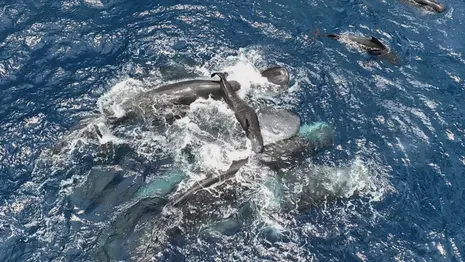
Sperm Whale Birth Captured by Researchers as Unrelated Individuals Assist in Delivery
Researchers recently captured footage of a sperm whale giving birth, with a group of other females collaborating to aid the mother and her newborn. The event took place in the Caribbean waters near Dominica, where a team from Project Ceti, an international initiative focused on whale communication, observed a pod of 11 whales. The mother, a 19-year-old named Rounder, was surrounded by family members and additional females as she delivered her second calf.
The process was meticulously recorded over nearly five and a half hours, using drones, underwater microphones, and direct observation from a nearby boat. The data, shared in a study published on Thursday in Scientific Reports and Science, marks a rare occurrence in scientific history. Among the 93 cetacean species, only nine have been documented giving birth in the wild, making this event exceptionally uncommon.
Coordinated Efforts from Non-Related Whales
What made this birth even more remarkable was the involvement of whales not directly related to Rounder. Shane Gero, a member of Project Ceti, highlighted this in a
“This is the first evidence of birth assistance in non-primates. It’s fascinating to witness the intergenerational support from the grandmother to her labouring daughter, as well as the assistance from other, unrelated females.”
The group’s actions included positioning themselves under Rounder’s dorsal fin, with some diving to support her during the critical moments of labor.
As the calf emerged, the pod’s behavior shifted rapidly. All adults gathered around the newborn, wrapping their bodies around it and using their heads to gently touch and guide the infant. The whales also angled their noses toward the calf, helping to maneuver it under the water and onto their bodies above the surface. This cooperative behavior, observed over 34 minutes, is believed to date back more than 36 million years.
According to the study, this unique form of assistance evolved as cetaceans transitioned back to aquatic life. Their ancestors once lived on land, and returning to the ocean required adaptations to ensure newborn survival. For instance, whale calves are born tail-first, a trait that helps them float immediately after birth. Despite this, they still sink initially, so other whales play a vital role in lifting the calf to facilitate its first breaths.
Unique Mammalian Behavior and Vocal Coordination
Such cooperative birthing is typically associated with primates, including humans. However, this footage challenges that notion, revealing sperm whales as another species displaying similar social support. The researchers also noted changes in the whales’ vocal patterns during key moments, suggesting coordination among the group to protect the calf or aid the delivery process.
Following the birth, the pod was not seen again for over a year. Recently, the newborn was spotted alongside Accra and Aurora, two other young members of the pod. This sighting was interpreted as a positive sign, indicating the calf had survived its first year—a critical milestone for reaching adulthood. The calf’s early survival underscores the importance of collective care within whale communities, where young individuals often become the focus of social attention as mothers seek food.
