
Is Iran’s regime at a breaking point?
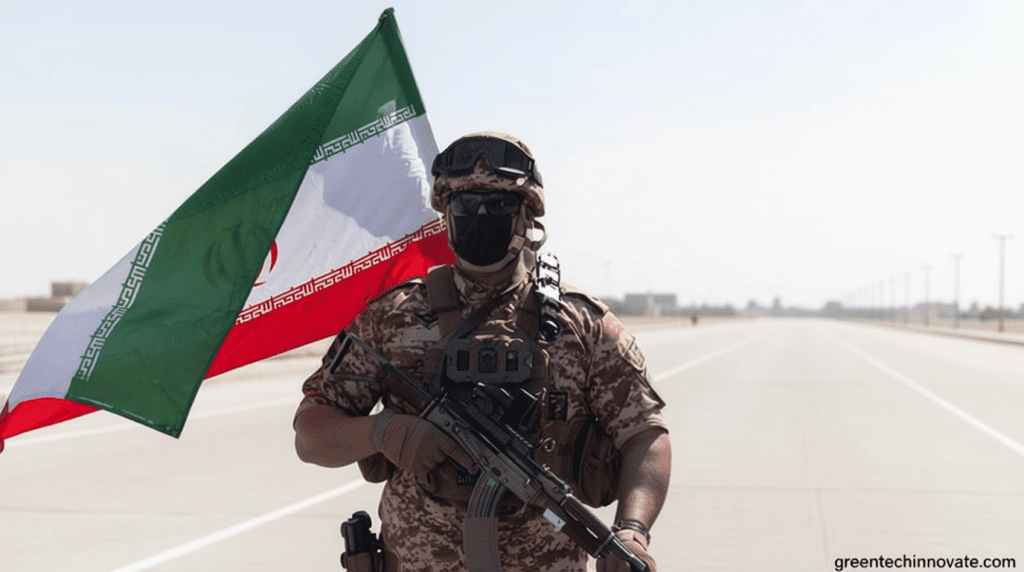
Is Iran’s Regime at a Breaking Point?
Eighteen days after the conflict began, Iran’s Revolutionary Guards remain operational despite heavy losses. Their flexible command setup has allowed them to persist in military actions, even as pressure mounts within the leadership structure.
“By the third week of hostilities, the initial assumption that Iran’s power base had been shattered proved incorrect. The regime has stabilized itself,” remarked Habib Hosseini-Fard, a Middle East analyst.
Though the US and Israel struck early, targeting Supreme Leader Ali Khamenei and other top figures, the Islamic Republic’s core institutions have endured. The IRGC continues launching attacks on the US, Israel, and neighboring Arab states, relying on a decentralized command system that allows swift decision-making.
Recent reports indicate Israeli strikes eliminated key figures, including Ali Larijani, head of the Supreme National Security Council, and Gholamreza Soleimani, leader of the Basij militia. CENTCOM noted over 300 strikes across multiple fronts, targeting countries like Oman, Saudi Arabia, Israel, Jordan, and the UAE. Saudi Arabia’s military intercepted more than 60 drones in its airspace since midnight, reflecting the war’s broad reach.
Iran’s Foreign Minister, Abbas Araghchi, has ruled out talks, insisting no ceasefire will happen as long as the US and Israel attack Iranian assets. He appears confident in the IRGC’s ability to adapt, maintaining operational flexibility amid shifting dynamics.
The Evolution of the IRGC
Formed after the 1979 Islamic Revolution, the IRGC was created to shield the regime from potential coups and uphold its ideological foundations. Today, it operates as a key component of Iran’s armed forces, under the guidance of Supreme Leader Mojtaba Khamenei. With an estimated 200,000 personnel, its influence extends beyond military domains.
“The IRGC has transformed from a traditional hierarchy into a decentralized network over two decades,” Hosseini-Fard explained. “Provincial units now hold significant autonomy, functioning independently of central command,” he added.
This adaptability, combined with Iran’s strategic assets like underground missile silos, ensures its military infrastructure cannot be swiftly dismantled. “This explains why attacks continue despite claims of total destruction,” Hosseini-Fard noted.
Political analyst Reza Talebi cautions against viewing the regime as vulnerable. “The idea that a weakened state automatically leads to military surrender doesn’t reflect Iran’s structural resilience,” Talebi said. He highlighted that ideological actors within the security apparatus are deeply tied to the system’s survival.
Talebi emphasized the IRGC’s broader role, beyond combat. “They control economic and ideological networks that stretch far beyond Iran’s borders,” he stated. These include the Quds Force, a specialized unit of the IRGC, and militant groups across the Middle East aligned with Iran’s strategic aims, such as the destruction of
