
National Mall prayer event sparks concern about Trump administration eroding the wall between church and state
National Mall Prayer Event Sparks Debate Over Church-State Separation
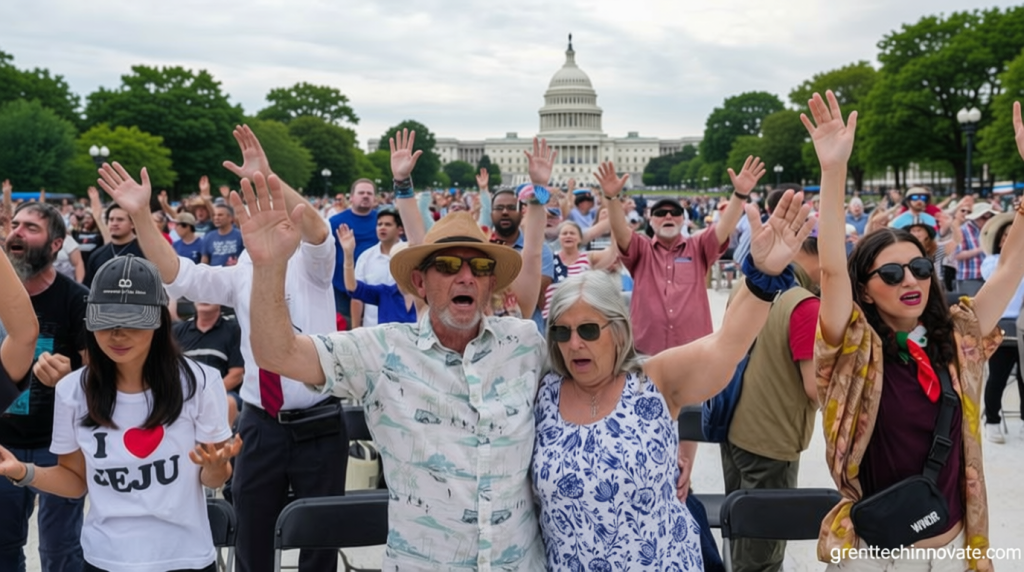
National Mall prayer event sparks concern – The White House’s support for a full-day prayer gathering on the National Mall last Sunday has reignited discussions about the Trump administration’s approach to maintaining the distinction between religious practice and government involvement. The event, titled “Rededicate 250: A National Jubilee of Prayer, Praise & Thanksgiving,” was part of broader commemorations marking the nation’s 250th anniversary. It drew thousands of attendees, including faith leaders, public figures, and citizens, as they came together to celebrate shared spiritual values ahead of the anniversary of the United States’ founding.
Event Overview and Key Participants
Spanning the entire day, the ceremony featured a blend of music, speeches, and religious rituals. Attendees were greeted by a stage designed with towering white columns and stained glass depictions of the Founding Fathers, creating a visually symbolic backdrop for the event. Video messages from President Donald Trump and senior Cabinet members were among the highlights, with Trump reading a passage from the Bible’s Book of Chronicles during the finale. House Speaker Mike Johnson, a prominent Christian figure, delivered a prayer emphasizing “piety and patriotism,” while Vice President JD Vance’s remarks underscored the idea of America as a “nation of prayer.”
The gathering, organized by the nonprofit Freedom 250, aimed to honor the nation’s heritage through collective worship. Freedom 250, a subsidiary of the National Park Foundation, serves as the National Park Service’s fundraising arm. According to a statement from the group’s senior adviser, Danielle Alvarez, the event was intended to reflect on historical milestones and reaffirm national ideals. “This moment offers an opportunity to look back, commit to our values, and envision a future filled with renewed purpose,” Alvarez remarked, highlighting the event’s symbolic significance.
While the invitation list was inclusive, the attendees largely represented evangelical Christians, with only a few faith leaders from other traditions present. This composition has drawn attention to the event’s focus on a specific religious tradition. A planning webinar, later deleted, described the event as a celebration of “our heritage as a Judeo-Christian” nation, a framing that some critics argue reinforces a particular religious narrative over a pluralistic one.
Reactions and Constitutional Concerns
The event has become a focal point for debates over the First Amendment’s establishment clause, which mandates the separation of church and state. Legal scholars and commentators have expressed differing opinions on its constitutionality, reflecting broader tensions over religious influence in public life. Andrew Koppelman, a constitutional law professor at Northwestern University, argued that the event was lawful, stating that no court had issued an injunction to block it. However, he noted that the initiative “contrary to the fundamental purposes of the Constitution,” as it promoted a specific faith rather than remaining neutral.
“This kind of divisive embrace of a particular religion and trying to associate the incumbent administration with that religion is bad for religion, bad for government, and bad for America,” Koppelman said in his analysis.
In contrast, Douglas Laycock, a religion and law expert at the University of Texas School of Law, described the event as “flagrantly unconstitutional.” Laycock contended that the government’s active promotion of Christianity, especially through explicit references to its historical role in the nation’s foundation, violated the principle of religious neutrality. “It is unconstitutional because it is explicit government promotion of religion, and not just religion in general, but of a fairly specific version of one particular religion,” he explained.
Michael Moreland, a professor of law and religion at Villanova University, offered a more moderate perspective. He argued that the intersection of faith and public life is not inherently problematic, pointing to established practices like prayers at congressional sessions and the presidential inauguration. “I think that it’s kind of overemphasizing that idea of separation to think an event like this raises any constitutional issues,” Moreland said. “The First Amendment allows for religious expression in the public square, and this event is a natural extension of that.”
Public Participation and Symbolic Meaning
Despite the event’s religious focus, many attendees expressed a sense of unity and shared purpose. Vicky Kanaga, a visitor from Massachusetts, told CNN she traveled to Washington specifically to participate, believing the event provided a chance to “turn our country back to God.” Similarly, Ryan Phillips, who joined with his family from Mississippi, stated that the gathering represented a celebration of “the religious and moral tradition” that he sees as foundational to American identity.
Phillips acknowledged the concerns raised by critics but maintained that the concept of church-state separation should not be interpreted as an absolute barrier. “The government should not come into the church, not the other way around,” he said, suggesting that the event’s spiritual focus did not undermine the separation principle but rather highlighted its enduring relevance.
Other attendees echoed this sentiment, viewing the event as a meaningful expression of national values. Some emphasized the historical connection between religion and the nation’s founding, while others saw it as a modern attempt to revive traditional spiritual practices. The presence of diverse faith groups, including one Orthodox rabbi and two conservative Catholic bishops, was noted, though critics argued their numbers were insufficient to represent the full spectrum of American religious life.
Broader Context of the Trump Administration’s Faith Initiatives
The National Mall prayer event is not an isolated occurrence but part of a larger pattern of faith-driven initiatives under the Trump administration. These efforts have included policy moves that prioritize religious values, as well as public events that celebrate Christianity’s role in American history. For instance, the administration has promoted religious liberty as a core principle, while also advancing programs that align with Christian perspectives on social issues.
These actions have sparked both support and criticism. Proponents argue that the government has a role in recognizing religious traditions that have shaped the country, while opponents warn of an overreach that could marginalize other faiths. The event on Sunday was seen as a continuation of this trend, with its emphasis on a Judeo-Christian heritage and its use of taxpayer funds alongside private donations to facilitate the gathering.
White House spokeswoman Taylor Rogers defended the event, stating that Rededicate 250 was designed to foster a sense of shared heritage and collective hope. The administration highlighted the event’s bipartisan appeal, noting that it brought together individuals from various backgrounds to reflect on the nation’s past and future. However, some argue that the event’s religious tone overshadowed its commemorative intent, raising questions about the balance between public expression and government endorsement.
As the debate over the event’s implications continues, it underscores the ongoing dialogue about the role of religion in public life. While some see it as a celebration of America’s spiritual roots, others view it as a potential erosion of the constitutional principle that separates church and state. The gathering’s impact will likely be measured not only by its immediate symbolism but also by its long-term influence on how religious values are integrated into government functions and cultural narratives.
