
Timmy, the stranded humpback whale, found dead off Danish coast
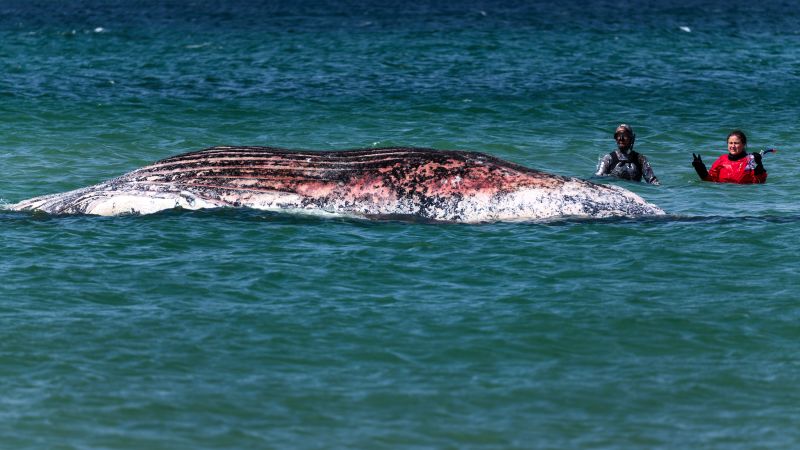
Timmy, the Stranded Humpback Whale, Found Dead Off Danish Coast
Timmy the stranded humpback whale found – Timmy, a young humpback whale who had spent weeks trapped in shallow waters, has been discovered lifeless just off Denmark’s coast, according to the Danish Environmental Protection Agency. The whale’s death occurred shortly after a contentious rescue mission successfully released him, marking a bittersweet end to a story that captured global attention. The agency confirmed the whale’s identity through a tracking device retrieved during the rescue effort, shedding light on the circumstances that led to his final fate.
A Stranding in Germany
Timmy’s journey began in early March when he was spotted in Wismar harbor, Germany, entangled in a fishing net. Emergency services intervened, freeing the whale after a tense operation. However, his struggle was far from over. By late March, Timmy became stranded near Timmendorfer Strand, a coastal town in northern Germany, where he received his nickname. The event sparked a dramatic rescue attempt, drawing media coverage and public scrutiny as the whale’s condition was broadcast live online.
“The stranded humpback whale near Anholt is the same whale that was previously stranded in Germany and was the subject of rescue attempts,” Jane Hansen, head of division at the Danish Environmental Protection Agency, told CNN on Saturday.
The whale’s ordeal was compounded by his deteriorating health, as he spent days barely moving and exhibited irregular breathing. His skin also suffered due to the low salt content of the Baltic Sea, a condition that left him vulnerable and weak. These factors raised concerns among marine experts, who warned that the whale’s survival was uncertain.
The Controversial Rescue Attempt
Despite the bleak prognosis, a privately funded rescue operation took place, aiming to save Timmy’s life. The effort involved guiding the whale into a barge before transporting him out to sea, a move that critics argued was unnecessary and potentially harmful. “I believe the whale will die very soon now,” Thilo Maack, a marine biologist for Greenpeace, told the Associated Press in April. “And I would also like to raise the question: What is actually so bad about that? … Yes, animals live, animals die. This animal is really, really very, very, very sick. And it has decided to seek rest.”
The decision to proceed with the private rescue, however, was supported by some officials. Till Backhaus, the province’s environment minister, allowed the operation to continue, emphasizing that it was a necessary step to give the whale a chance at survival. “To use even the smallest chance when a life is at stake,” he explained to the Associated Press. “That’s what we do in such situations.”
Confirming Identity with Technology
Timmy’s identity was finally verified by the Danish Environmental Protection Agency after a worker recovered the tracking device attached to him during the rescue. The device’s position and appearance matched those of the whale previously observed and handled in German waters, confirming his return to the sea. This discovery added a layer of significance to his death, as it tied together two separate incidents in different locations.
The whale was found on Friday near the island of Anholt, located in the Kattegat Strait between Denmark and Sweden. This area, approximately 130 kilometers from where he had been released, became the final resting place for Timmy. The agency noted that there are no immediate plans to remove his carcass, as it currently poses no threat to the surrounding environment.
“It is not currently considered to pose a problem in the area,” the Danish Environmental Protection Agency stated. “People are urged to maintain a safe distance and avoid approaching the whale for health reasons and in case it explodes.”
Public Reaction and Ethical Debate
The rescue effort ignited a heated debate over the ethics of intervening in nature. Supporters viewed it as a courageous act to give Timmy a second chance, while detractors called it an example of animal cruelty. The controversy highlighted the divide between scientific caution and human intervention in wildlife rescue. Some argued that the whale’s inability to navigate on his own justified the rescue, while others questioned the necessity of subjecting him to additional stress.
Timmy’s death serves as a poignant reminder of the challenges faced by marine life in human-altered environments. The incident also underscores the role of technology in tracking and understanding the movements of these creatures. The tracking device, which was initially meant to monitor his recovery, became a crucial piece of evidence in confirming his identity after the rescue attempt.
A Tale of Two Strandings
Timmy’s journey illustrates the complexities of whale stranding events. First, he was found in Germany’s Wismar harbor, where his entanglement in a fishing net required swift action. Then, he was stranded in shallow waters near Timmendorfer Strand, an area that had already earned him a name. The two events, separated by just a few weeks, created a narrative of resilience and struggle.
During his time stranded, Timmy’s condition worsened, with his body showing signs of exhaustion and damage from prolonged exposure to the low-salinity waters of the Baltic Sea. This environment, which is less salty than the open ocean, can lead to skin erosion and other health issues in marine animals. The combination of these factors made his survival increasingly unlikely, even as rescue teams worked tirelessly to aid him.
Legacy of a Tragic Rescue
The story of Timmy is now a case study in the challenges of wildlife rescue. While the operation provided a hopeful moment, it also exposed the risks involved in such endeavors. The whale’s eventual death near Anholt has prompted discussions about the balance between human intervention and natural processes. Experts are now analyzing the incident to determine whether the rescue efforts were justified or if they contributed to Timmy’s demise.
As the carcass remains in the water, it stands as a silent testament to the whale’s journey. The Danish Environmental Protection Agency has encouraged the public to respect the natural cycle, emphasizing that Timmy’s death is part of a larger story of survival and adaptation. The whale’s fate will likely influence future decisions on how to handle similar cases, ensuring that both the science and the emotion of the situation are considered.
