
Iran’s internet blackout fuels fear and isolation
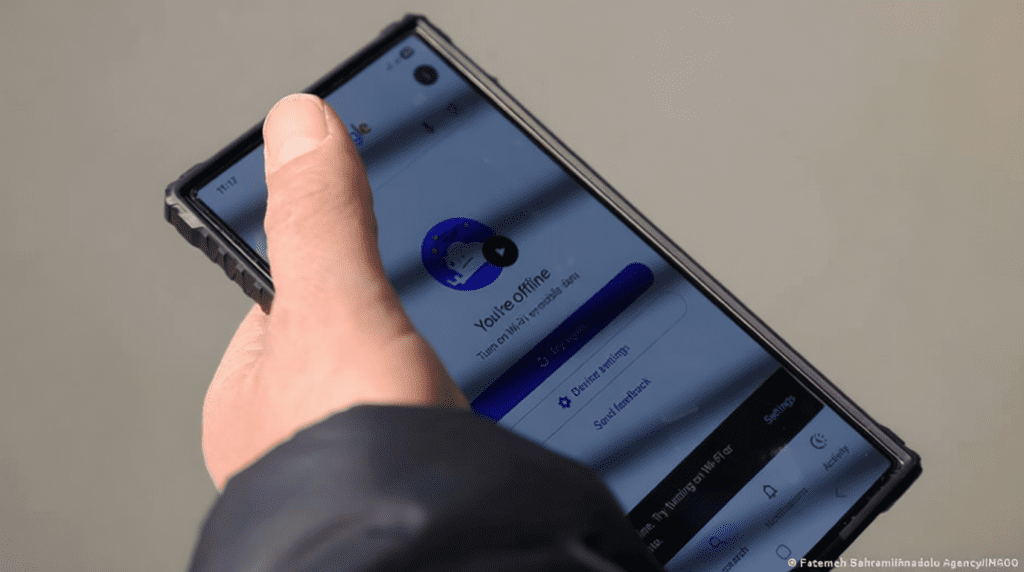
Iran’s Internet Blackout Heightens Anxiety Amid Strains of War
As tensions escalate between Iran and its adversaries, the country has faced a severe internet disruption, leaving citizens in a state of confusion and separation. Residents describe the situation as increasingly difficult, with concerns over family members’ safety and the unfolding events weighing heavily on their minds. The attacks began on Thursday, when Tehran became a primary target, witnessing low-flying jets and powerful explosions.
Strikes Target Iran’s Core Infrastructure
On Friday, the Israeli military confirmed its assault on “the heart of Tehran,” aiming to damage key infrastructure linked to the Iranian regime. Meanwhile, the US had delayed its potential strike on Iran’s energy facilities, citing the need to address the blockade of the Strait of Hormuz. The Pentagon has stationed thousands of troops in the region, with a ground invasion still a possibility.
Information Access Under Threat
Iran’s state media, once a dominant force, now struggles to maintain credibility. A recent survey revealed that only 12.5% of Iranians relied on it for news prior to the June 2025 Twelve-Day War, compared to 51% in 2017. Despite a 50% budget boost in March 2025, the Islamic Republic of Iran Broadcasting (IRIB) has failed to restore public trust.
Many Iranians now turn to international Persian-language outlets, platforms like Instagram, or other state broadcasters such as DW for updates. However, these services are officially restricted, forcing users to rely on virtual private networks (VPNs) to bypass the block. A VPN forms an encrypted link between a device and a remote server, enabling access to global content.
Since the US-Israel conflict with Iran began on February 28, the government has cut off internet access entirely. Even basic VPN usage requires satellite providers like Starlink, which are also banned. These services are costly, with prices reaching up to ten times the usual rate. The Ministry of Intelligence has tracked and seized hundreds of Starlink systems nationwide.
Tracking and Capturing Banned Systems
Internet expert Keyvan Samadi explained how security forces monitor such systems. He noted that Starlink devices emit signals to connect with satellites, detectable by specialized equipment. Radio triangulation can pinpoint their locations. Over the war’s duration, hundreds have been arrested for using these services.
Residents report that while VPNs remain accessible, their high cost limits usage. Despite financial strain from the ongoing conflict, many prioritize staying informed. They highlight that the internet blackouts add to the psychological burden, severing communication with loved ones and amplifying the sense of unpredictability.
“We no longer watch state TV, and few people do either,” shared a Tehran resident in a group chat. “It only serves its own agenda and loyalists.”
“The uncertainty about what’s happening is nearly overwhelming,” added another. “People have lost touch with their families, and the fear is growing.”
This article was contributed by Danyal Babayani and translated from German.
