
No timeframe for ending US war against Iran, says Pete Hegseth
No timeframe for ending US war against Iran, says Pete Hegseth
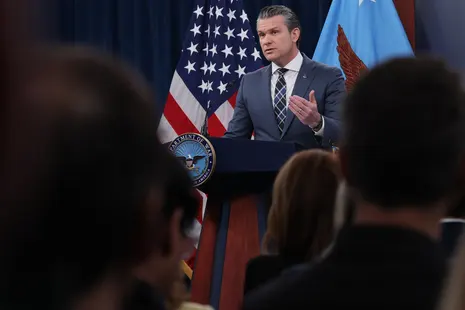
Defense Secretary Pete Hegseth addressed the ongoing conflict with Iran on Thursday, emphasizing that the United States has not established a specific timeline to conclude the campaign. He acknowledged the possibility of seeking additional funding, with reports suggesting the Pentagon might request over $200 billion from Congress. The military operation, launched three weeks prior, has escalated in scope, with strikes spreading across Iran and its allied networks.
Speaking at the Pentagon, Hegseth stated that the current phase of the war would see the most significant US aerial assault yet. “We’ve targeted more than 7,000 locations, including Iran’s military infrastructure,” he said. “This day will mark the largest strike package so far, delivering devastation from above.” Despite rising oil prices and a decline in Trump’s approval ratings, Hegseth refused to outline a strategy for withdrawal, asserting that the decision to end the conflict would rest solely with the president.
“We wouldn’t want to set a definitive timeframe,” Hegseth remarked. “It will be at the president’s choosing, ultimately, where we say, ‘Hey, we’ve achieved what we need to.'”
The war’s objectives, he explained, remain focused on dismantling Iran’s missile capabilities, weakening its defense industry, and neutralizing its naval forces. “Our goals, as directed by our America-first leader, are unchanged,” Hegseth declared. “These are not the media’s objectives, nor Iran’s, but the clear mission we’ve pursued from the beginning.”
Meanwhile, the conflict has expanded beyond Iran’s borders. In the Gulf, US aircraft and naval assets have engaged in coordinated strikes against Iranian vessels, including mine-layers and submarines, aiming to secure the Hormuz strait. Long-range munitions now target underground facilities and coastal missile sites, with operations extending deeper into Iranian territory. General Dan Caine, a top military official, noted the strategic shift in focus, highlighting the use of A-10 jets to track fast-attack crafts and Apache helicopters to disrupt militia groups in Iraq.
Hegseth also criticized the media, accusing it of undermining the administration’s efforts. “A dishonest and anti-Trump press will stop at nothing to downplay progress, amplify every cost, and question every step,” he said. “TDS [Trump derangement syndrome] is in their DNA. They want President Trump to fail.”
As the war intensifies, the Pentagon’s financial demands have grown. The first six days of operations cost nearly $13 billion, according to recent reports. “The $200bn figure could shift, as it takes resources to neutralize threats,” Hegseth noted. “We’re returning to Congress to ensure proper funding for what’s been done and what’s yet to come.”
In closing, Hegseth urged Americans to pray for troops, invoking a religious tone. “Pray for our forces on bended knee with your family, in your schools, in your churches, in the name of Jesus Christ,” he implored. “The world, the Middle East, even segments of our own press should be thanking President Trump for his boldness in confronting this terror state.”
