
A free Iran is their shared dream. But the diaspora remains torn on the best path forward.
A Free Iran Is Their Shared Dream. But the Diaspora Remains Torn on the Best Path Forward
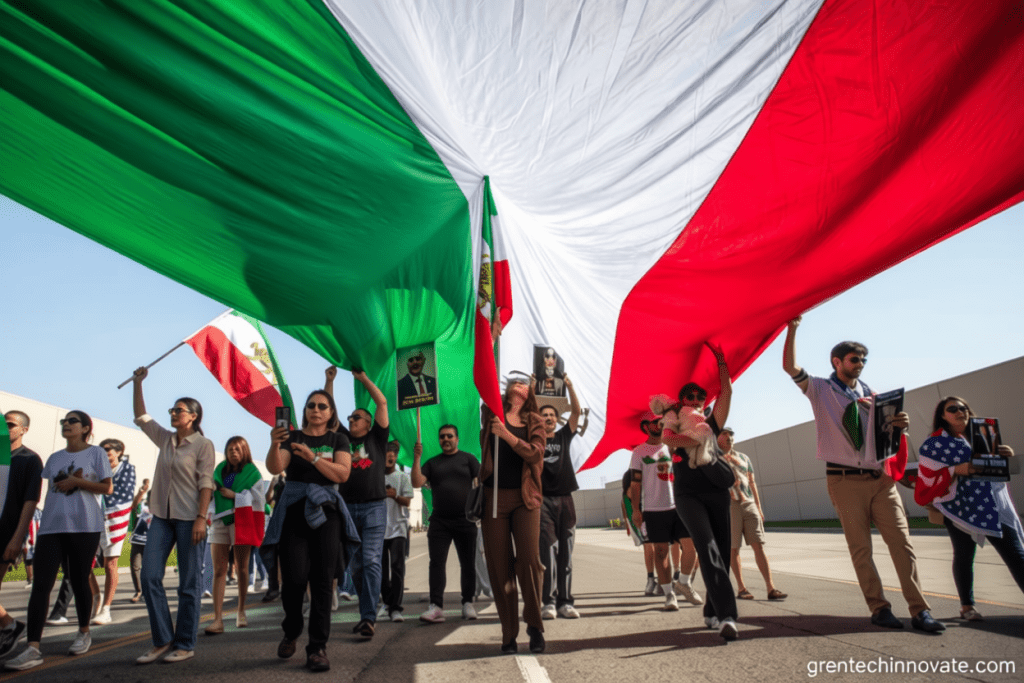
Los Angeles has become a focal point for contrasting views within the Iranian diaspora, as tensions mount in the homeland. Last Saturday, two demonstrations unfolded side by side: one in front of City Hall, where hundreds of Iranian Americans marched against the initiation of an unsanctioned war, and another on the Westside, in the neighborhood dubbed “Tehrangeles,” where the same community celebrated what they saw as a potential turning point for regime change. The divide among diaspora members highlights their deep emotional responses to escalating violence in the Middle East, especially for those whose families escaped the theocratic rule established after the 1979 Islamic Revolution.
Abbas Milani, director of Iranian studies at Stanford University, noted the shift in sentiment. “Some people are so aggrieved at this regime that they say, ‘At any cost, come and destroy this regime even if it means destroying parts of the country,’” he explained. “Others want to get rid of the regime but not at the expense of war.” This ideological rift contrasts with earlier this year, when the diaspora largely rallied behind Iranians resisting the government’s harsh measures. Now, the same group is split over methods to achieve their goal of a free Iran.
The internet blackout imposed by the Iranian government has heightened the sense of urgency, cutting off communication with loved ones. As the death toll rises and historic sites face destruction, the diaspora grapples with conflicting emotions. Meanwhile, Nowruz—Persian New Year, a time for renewal and celebration—looms. Rumors suggest Mojtaba Khamenei, the supreme leader’s son, could step into the role, raising questions about the future of leadership in the country.
Analysts highlight the potential for the Islamic Revolutionary Guard Corps to consolidate power if the current conflict persists. President Donald Trump has also weighed in, expressing a desire to remove Iran’s leadership entirely and proposing names for a “good leader.” However, a recent NBC News poll reveals that 54% of potential voters disapprove of his approach to the situation, reflecting a broader divide in American opinion that mirrors the diaspora’s internal conflict.
Online discourse among Iranians has intensified since the strikes. Supporters of military action are often labeled “Zionists,” a term increasingly used as a derogatory label for Jews since the Hamas attacks on Israel in October 2023. Anti-war advocates, meanwhile, face accusations of being pro-regime. These tensions underscore the complexity of the diaspora’s stance, even as they all aspire to a free Iran.
“We are not a monolith,” wrote the Iranian Diaspora Collective, an Instagram account with over 81,000 followers, emphasizing the diversity within the community. Los Angeles-based pastor Ara Torosian, a Christian who fled Iran in 2010, shared his perspective. “This is not just a war for freedom—it’s a reckoning for decades of oppression,” he said, noting the pain of seeing historic sites destroyed and innocent lives lost, particularly young children.
“The images of the destruction and the very joyous support that some give to the idea of war has become a source of more tension than we normally get in the diaspora,” Milani said. “It will get harder before it dissipates.”
Last year, the National Iranian American Council (NIAC), a nonpartisan organization, and YouGov conducted a survey showing 53% of Iranian Americans opposed U.S. military action against Iran. A new poll is set to release updated figures soon. As the situation evolves, the diaspora’s unity remains fragile, with debates over leadership and strategy shaping their collective future.
