
China’s AI industry looks unstoppable in the race to best US rivals. But is it?
China’s AI Leaders Weigh Prospects for Overtaking U.S. Firms
At a major gathering in Beijing in January, China’s leading AI firms faced a pivotal question: What are the chances of a Chinese AI company surpassing U.S. competitors within the next three to five years? A top AI scientist present offered a stark assessment, stating,
“Below 20 percent,”
said Justin Lin, technical lead for Alibaba’s Qwen AI models. “And I think 20 percent is already very optimistic.”
The cautious outlook contrasted with a year marked by headlines praising China’s AI surge. After a lesser-known startup, DeepSeek, stunned the world with an AI model developed at a fraction of the cost of American counterparts, Chinese firms dominated global model downloads and secured massive funding through initial public offerings.
Persistent Challenges in AI Development
Despite the celebratory tone, some Chinese AI developers have cautioned that the country may have widened its gap in creating cutting-edge models. Experts highlight restricted access to advanced chips and limited capital as ongoing obstacles. Lin was not alone in this view. Tang Jie, co-founder of Z.ai (Zhipu), echoed the sentiment,
“In some areas we may be doing fairly well, but we also need to acknowledge the challenges and gaps we still face,”
he said during the same Beijing event.
China’s Open-Source Strategy and Global Impact
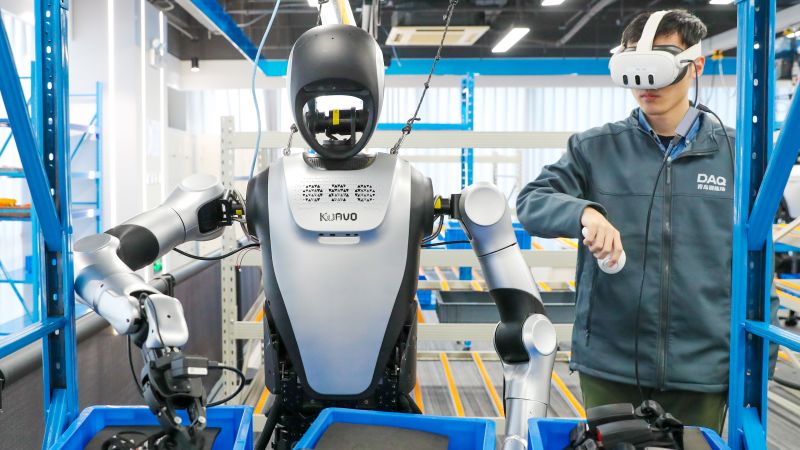
However, this evaluation does not signal stagnation in China’s AI industry. Constraints on high-performance chips and capital have driven a distinct approach—making AI models freely accessible or open source. This strategy, seen as a means to expedite progress and counter U.S. rivals, has yielded significant results. Companies are rapidly deploying AI applications based on these models across real-world scenarios, integrating the technology into manufacturing, e-commerce, and robotics.
In a televised New Year address, Chinese leader Xi Jinping praised the country’s swift rise in innovation, citing AI models that are “racing ahead” and breakthroughs in domestic chip production as part of Beijing’s push for technological self-reliance. Qwen, for instance, surpassed Meta’s Llama in September as the most-downloaded open model on Hugging Face, a key platform for AI tools. Even U.S. firms like Airbnb have adopted it for AI-driven customer service.
Unprecedented Growth in AI Listings and International Attention
An extraordinary wave of Chinese AI listings has also emerged in Hong Kong. In January, unicorn startups Z.ai and MiniMax—both creators of competitive open models—went public, raising $560 million and $620 million respectively, with share prices surging. Global tech giants are taking notice. In December, Meta announced its acquisition of Manus, a Chinese AI agent firm that later relocated to Singapore. While the deal has sparked discussions, it underscores the growing influence of China’s AI advancements on the global stage.
